


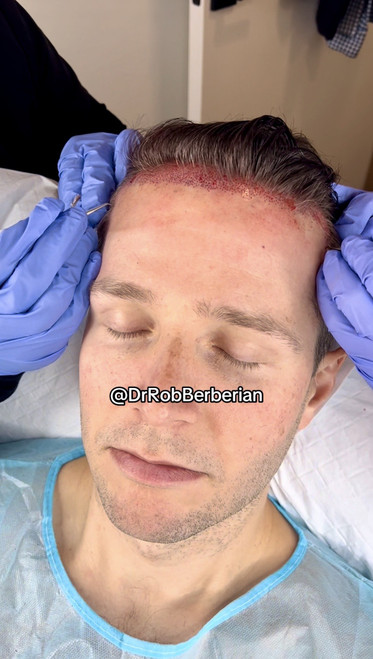


Does GLP-1 Cause Hair Loss? Factors: Treatment For Hair Loss Due to GLP-1
Ozempic, Wegovy, and Zepbound have changed how millions of Americans lose weight, but a growing number of patients are also losing hair. Dr. Rob Berberian breaks down the real mechanism behind GLP-1 hair shedding, who's at risk, and the full range of medical and surgical hair restoration options available in Newport Beach, Orange County, and across California, from minoxidil and supplements to PRP, Exosome Hair Treatment, and FUE Hair Transplant.
Introduction
If you've started noticing more hair in the shower drain or on your pillow since beginning a GLP-1 medication like Ozempic (semaglutide), Wegovy (semaglutide), Mounjaro (tirzepatide), or Zepbound (tirzepatide), you are not imagining it, and you are not alone. As GLP-1 receptor agonists have become one of the most widely prescribed drug classes in the United States for weight loss and type 2 diabetes, hair loss has emerged as a real, documented, and increasingly common concern among patients in Newport Beach, Orange County, Los Angeles, and across California.
Dr. Rob Berberian, a Newport Beach–based physician specializing in hair restoration and regenerative aesthetic medicine, treats patients from all over Southern California and across the United States for GLP-1–related hair thinning. This article explains exactly why GLP-1 medications can trigger hair loss, who is most at risk, what the current medical literature says, and, most importantly, the full spectrum of treatment options available today, from topical and oral medications to PRP, Exosome Hair Therapy, and FUE Hair Transplant.
Concerned about hair thinning on Ozempic, Wegovy, or Zepbound?
Dr. Rob Berberian offers in-person consultations in Newport Beach and virtual consultations for patients throughout Orange County, Los Angeles, California, and the rest of the USA.
The Mechanism
Why Does GLP-1 Cause Hair Loss?
Semaglutide and tirzepatide were not designed to affect hair, but the way they work indirectly puts hair follicles at risk. GLP-1 receptor agonists suppress appetite and slow gastric emptying, which commonly leads to rapid, substantial weight loss: often 15–20% of total body weight within a year.2,4 This kind of fast weight loss is a significant physiological stressor, and the hair follicle is exquisitely sensitive to metabolic stress.
The dominant mechanism identified across the medical literature is telogen effluvium, a diffuse, non-scarring shedding condition. Hair normally cycles through three phases: the anagen (growth) phase, the catagen (transitional) phase, and the telogen (resting/shedding) phase. Acute stress on the body, from rapid weight loss, caloric restriction, or nutritional deficiency, can prematurely push a large percentage of hair follicles from the growth phase into the shedding phase at once, producing the diffuse thinning many GLP-1 patients notice roughly two to three months after starting therapy or after their most rapid period of weight loss.1,3
A 2025 systematic review in the International Journal of Dermatology confirmed that among GLP-1 receptor agonists, semaglutide and tirzepatide showed the highest reported incidence of hair loss, with telogen effluvium and androgenetic alopecia (AGA) identified as the predominant subtypes. Tirzepatide, which produces the greatest average weight loss, was most frequently linked to telogen effluvium specifically.1
Beyond the weight-loss stress response, researchers have proposed several contributing mechanisms:
- Hormonal shifts, changes in insulin and insulin-like growth factor (IGF-1) signaling during rapid weight loss, may influence androgen activity and accelerate androgenetic alopecia in genetically predisposed patients.1
- Nutritional deficiency, reduced caloric and protein intake along with lower levels of key micronutrients such as vitamin D, iron, and zinc, can directly impair the hair growth cycle.1
- Psychosocial and metabolic stress, the physiological burden of adapting to a new medication and a changing body composition, can itself be a shedding trigger.1
- Direct receptor effects, more speculative research has explored GLP-1 receptor expression in dermal fibroblasts and adipose-derived stem cells, theorizing that receptor activation could alter local cytokine signaling in the scalp, though this remains an active area of investigation rather than established fact.3
Importantly, hair loss is not listed as a common side effect in the original semaglutide prescribing information, but pharmacovigilance data and post-marketing reports have made the association increasingly clear. In clinical trials of Wegovy, alopecia was reported in about 3% of adult patients on the medication versus 1% on placebo.7
Who Is Affected
Risk Factors for GLP-1–Related Hair Loss
Not everyone on a GLP-1 medication experiences hair thinning. Based on current pharmacovigilance and cohort data, several factors appear to increase risk:
- Pre-existing androgenetic alopecia, patients with a genetic predisposition to male or female pattern hair loss, may see it accelerate or become newly noticeable during rapid weight loss.
- Higher-dose semaglutide or tirzepatide use, doses under 2mg weekly are rarely implicated, while higher obesity-treatment doses show a clearer dose-dependent relationship.1
- Inadequate protein or micronutrient intake while appetite is suppressed.
- Underlying thyroid disease, iron deficiency, or other chronic conditions that independently affect the hair cycle.
- Concurrent illness or major life stress occurring alongside GLP-1 therapy.
Persistent, patchy, or scarring hair loss is never "just" GLP-1-related shedding and always warrants an in-person evaluation to rule out alopecia areata, scalp psoriasis, or thyroid-related alopecia.
By The Numbers
How Common Is GLP-1 Hair Loss?
With roughly one in eight U.S. adults now reporting having used a GLP-1 medication for weight loss, diabetes, or both, hair loss has moved from an anecdotal complaint to a formally studied adverse event.4 A large 2025 scoping review identified hair loss as an "emerging" adverse effect worth systematic investigation, noting that most existing studies lack formal dermatologic diagnostic confirmation, meaning real-world prevalence is likely underreported.3 Wegovy's own clinical trial data reported alopecia in about 3% of adult users compared to 1% of those on placebo, and in adolescent patients, 4% versus 0%.7 While that makes hair shedding far less common than nausea or gastrointestinal symptoms, it is frequently discussed within online weight-loss communities and is one of the more common reasons patients in Newport Beach and Orange County are now seeking evaluation for hair restoration alongside their weight-loss treatment.
Research Frontier
New & Potential Future Treatments
The relationship between GLP-1 medications and hair is an active area of dermatologic research, and the picture is more nuanced than "GLP-1 causes hair loss." Interestingly, several case reports have also described hair regrowth or stabilization in patients on GLP-1 therapy, particularly when hair loss was originally driven by insulin resistance or metabolic dysfunction, since improved glycemic control can, in some patients, benefit certain hair loss subtypes such as central centrifugal cicatricial alopecia (CCCA) and androgenetic alopecia.1
Emerging and investigational directions being discussed in the literature include:
- Personalized risk stratification, using dose, sex, rate of weight loss, and baseline hair status to predict which patients need proactive hair-protective counseling before starting a GLP-1.
- Combination regenerative protocols, pairing nutritional optimization with PRP or exosome-based therapies during periods of rapid weight loss to support the follicle through the shedding phase.
- Exosome and growth-factor therapies derived from mesenchymal stem cells, which are being studied for their ability to stimulate dermal papilla cells, activate hair follicle stem cells, and promote local angiogenesis.9,10
- Refined pharmacovigilance monitoring as prescription volume continues to climb, allowing researchers to better separate true drug-driven alopecia from weight-loss-driven telogen effluvium.
Treatment Options
Managing Hair Loss From GLP-1 Medications
The good news: GLP-1-associated telogen effluvium is usually temporary, and there is a well-established toolkit of medical and regenerative options to support regrowth while you continue your weight-loss journey. Dr. Rob Berberian builds individualized treatment plans for patients throughout Newport Beach, Orange County, Los Angeles, and California combining the following approaches.
1. Topical & Oral Medications
Minoxidil remains the most widely studied first-line medical therapy for hair loss. Available in topical and oral (low-dose) form, minoxidil works by prolonging the anagen (growth) phase and increasing blood flow to the follicle, and it is frequently recommended as a foundation therapy for patients experiencing telogen effluvium or androgenetic alopecia while on GLP-1 medications.13
2. Platelet-Rich Plasma (PRP)
PRP therapy uses a concentrated preparation of your own blood platelets, rich in growth factors like EGF, IGF-1, and VEGF, injected directly into the scalp to stimulate dormant follicles. A randomized controlled trial in women with androgenetic alopecia found that 57% of PRP-treated patients showed clinical improvement at 24 weeks compared to just 7% in the placebo group, with statistically significant increases in hair density at both 8 and 24 weeks.11 A 2023 meta-analysis of nine randomized trials confirmed that PRP significantly increases hair density at 3 and 6 months compared to placebo.12
3. Exosome Hair Injections
Exosome therapy is one of the newer, most talked-about regenerative options in hair restoration. Exosomes are cell-derived nanovesicles carrying growth factors and signaling molecules that can stimulate dermal papilla cells and activate hair follicle stem cells. A 2023 systematic review in the Journal of Cosmetic Dermatology found preclinical and early clinical evidence supporting exosome therapy's potential for hair regrowth, while noting that further large-scale clinical trials are still needed to fully define its long-term efficacy.9 Dr. Rob Berberian offers Exosome Hair Restoration in Newport Beach as a non-surgical option, often combined with PRP or FUE for enhanced results.
PRP Hair Restoration
A series of scalp injections using your own platelet-rich plasma to stimulate hair density and thickness.
$900 per session
Exosome Hair Injections
Advanced cell-signal therapy designed to activate dormant follicles and support regrowth. Learn more →
$4,500
4. Non-Surgical Solutions & Supplements
Nutritional support is essential during GLP-1 therapy, since appetite suppression can lead to inadequate protein and micronutrient intake. Dr. Rob Berberian frequently recommends hair-targeted supplementation (biotin, iron, vitamin D, zinc, and amino acids as clinically indicated), along with dermatologist-recommended non-surgical hair loss solutions for men and women available directly through the practice.
5. FUE Hair Transplant (Surgical)
For patients with more advanced thinning, established androgenetic alopecia, or hair loss that hasn't fully responded to medical therapy, Follicular Unit Extraction (FUE) hair transplant remains the gold-standard surgical option. See the full breakdown of the FUE process, downtime, and cost below.
What To Expect
Regrowth Potential & Realistic Timeline
Because most GLP-1-related hair loss is telogen effluvium rather than permanent follicle destruction, the regrowth potential is generally favorable, but patience is essential. Hair follicles that shift into the shedding phase typically take three to six months to re-enter active growth, and visible, noticeable regrowth commonly takes six to twelve months even after the underlying trigger (rapid weight loss, nutritional gaps) has been addressed.
Patients who also have underlying androgenetic alopecia, meaning genetic pattern hair loss that was simply unmasked or accelerated by the stress of rapid weight loss, will generally need ongoing medical therapy (minoxidil, PRP, or exosome treatment) or, for more advanced thinning, an FUE hair transplant to achieve a fuller, denser, permanent result.
Dr. Rob Berberian works with every patient to determine whether they are dealing with temporary shedding, underlying pattern hair loss, or a combination of both, an important distinction that shapes the entire treatment plan.
Protecting Your Results
Aftercare & Maintenance For Healthy Hair
Whether you're managing GLP-1-related shedding, recovering from a hair transplant, or maintaining results from PRP or Exosome therapy, proper aftercare is critical for long-term success:
- Use organic, sulfate-free shampoo and natural hair care products. Harsh, sulfate-heavy formulas can strip the scalp barrier and irritate follicles that are already under stress. Gentle, natural cleansers support a healthier scalp environment for regrowth.
- Prioritize protein and key micronutrients (iron, vitamin D, zinc, biotin), especially important while appetite is suppressed on a GLP-1 medication.
- Stay consistent with topical or oral minoxidil if prescribed, stopping and starting repeatedly reduces its effectiveness.
- Schedule maintenance PRP or Exosome sessions as recommended, these regenerative therapies work best as a series rather than a single treatment, and periodic maintenance sessions help sustain density over time.
- Avoid tight hairstyles, excessive heat styling, and aggressive brushing during periods of active shedding.
- Never stop a GLP-1 medication abruptly due to hair loss concerns without first speaking with your prescribing physician.
- Follow all post-procedure instructions closely after any FUE hair transplant, PRP, or Exosome session, including activity restrictions and scalp care during the initial healing window.
Ready to talk through your options?
Dr. Rob Berberian offers free consultations for patients throughout Newport Beach, Orange County, Los Angeles, California, and nationwide.
Surgical Option
FUE Hair Transplant: What It Is, The Process, Downtime & Cost
What is a hair transplant? A hair transplant is a surgical procedure that moves healthy, permanent hair follicles from a "donor" area of the scalp, typically the back and sides of the head, which are genetically resistant to balding, to thinning or bald areas. Follicular Unit Extraction (FUE) is the modern, minimally invasive technique in which individual follicular units are extracted one at a time using tiny punches (0.8–1mm in diameter), rather than removing a linear strip of scalp as in older FUT (strip) techniques.15,16
The FUE Process
- Consultation & design, Dr. Rob Berberian evaluates your donor supply, hair loss pattern, and goals, and designs a natural, artist-drawn hairline tailored to your face.
- Local anesthesia, the donor and recipient areas are numbed; the procedure is performed comfortably while you're awake.
- Graft extraction, individual follicular units are extracted one-by-one from the donor area using precision micropunches under magnification.17
- Graft placement, each follicular unit is meticulously placed into the recipient area at the correct angle and density to mimic natural hair growth patterns.
- Recovery begins, grafts begin to stabilize within the first 10–14 days.
Clinical outcome data on FUE is strong: a retrospective study of 158 male androgenetic alopecia patients found that more than 90% of transplanted hair follicles survived, with over 85% of patients achieving a follicle survival rate above 95% at twelve months post-operation.16
Downtime
FUE is typically performed as a one-day, outpatient procedure. Most patients return to non-strenuous work within 2–4 days. Mild scalp redness and pinpoint scabbing in the recipient area generally resolve within 7–10 days. Because FUE does not involve a linear incision, there is no linear scar and minimal post-procedural discomfort compared to older strip (FUT) techniques.15 Transplanted hairs typically shed within the first few weeks (an expected part of the process), with new growth beginning around month 3–4 and full, mature results visible at 9–12 months.
Cost For FUE Hair Transplant
FUE Hair Transplant
Manual FUE performed personally by Dr. Rob Berberian, natural hairline design, 1,000–4,000+ grafts, no-shave options available.
Starts from $8,000 and up
Learn More About FUE Hair TransplantDr. Rob Berberian performs manual FUE hair transplants for patients throughout Newport Beach, Orange County, Los Angeles, and California, as well as patients who travel from across the USA specifically for his artist-level hairline design and no-shave technique options. Read more about our full FUE Hair Transplant in Newport Beach.
For Executives & Public Figures
VIP FUE Hair Transplant, No-Shave Option
For patients who cannot take time away from the public eye, executives, entertainers, public-facing professionals, and celebrities throughout Los Angeles, Orange County, and Newport Beach, Dr. Rob Berberian offers the VIP FUE Hair Transplant, a discreet technique that does not require shaving the donor or recipient area. Individual grafts are extracted directly from unshaven hair, allowing patients to return to work and public life with no visible sign of having had a procedure.
This meticulous, more time-intensive approach is one of the reasons patients travel from across California and the rest of the United States specifically to see Dr. Rob Berberian for their hair restoration.
Explore VIP FUE Hair TransplantWho is VIP FUE ideal for?
- Executives & public-facing professionals
- Actors, media personalities & celebrities
- Patients who cannot take visible downtime
- Anyone who prefers a fully discreet, no-shave procedure
About Your Provider
Why Patients Choose Dr. Rob Berberian in Newport Beach
Dr. Rob Berberian specializes in manual FUE hair transplantation and regenerative hair restoration, combining an artist's eye for natural hairline design with an evidence-based approach to medical hair loss therapy, including GLP-1-related shedding. His Newport Beach practice, located at 200 Newport Center Dr. Suite 202, Newport Beach, CA 92660, serves patients throughout Orange County and Los Angeles, and regularly welcomes patients traveling from across California and the entire United States for consultations and procedures.
Take the Next Step Toward Healthier, Fuller Hair
Whether you're dealing with GLP-1-related shedding, hereditary thinning, or considering an FUE Hair Transplant, Dr. Rob Berberian offers personalized care for patients in Newport Beach, Orange County, Los Angeles, California, and across the USA.
Medical References
Citations
- Branyiczky MK, Lowe MS, McMullen E, Donovan J, Khosravi-Hafshejani T. Effects of GLP-1 Receptor Agonists on Hair Loss and Regrowth: A Systematic Review. International Journal of Dermatology. 2025;65(5):1030–1032. doi:10.1111/ijd.70133.
- Rojas Lopez RF, Lynett Barrera D, Amaya Muñoz MC, Saavedra Diaz MP. Alopecia as an Emerging Adverse Effect Associated With Glucagon-Like Peptide-1 (GLP-1) Receptor Agonists for Weight Loss: A Scoping Review. Cureus. 2025;17(8):e90021. doi:10.7759/cureus.90021.
- Gupta AK, Teasell EM, Economopoulos V, Mirmirani P. GLP-1 Therapies and Hair Loss: A Systematic Review of Current Evidence and Implications for Counseling. Science Progress. 2026;109(2). doi:10.1177/00368504261444578.
- KFF Health Tracking Poll. Approximately 1 in 8 U.S. adults report having taken a GLP-1 agonist medication. Cited in: Why Some People Lose Their Hair When They're On GLP-1s. CNN Health. November 14, 2025.
- Godfrey H, Leibovit-Reiben Z, Jedlowski P, et al. Alopecia Associated With the Use of Semaglutide and Tirzepatide: A Disproportionality Analysis Using the FDA Adverse Event Reporting System (FAERS) From 2022 to 2023. Journal of the European Academy of Dermatology and Venereology. 2025;39:e153–e154. doi:10.1111/jdv.20197.
- Burke O, Sa B, Cespedes DA, Sechi A, Tosti A. Glucagon-Like Peptide-1 Receptor Agonist Medications and Hair Loss: A Retrospective Cohort Study. Journal of the American Academy of Dermatology. 2025;92:1141–1143. doi:10.1016/j.jaad.2025.01.046.
- Drugs.com Medical Answers. Do Ozempic, Wegovy, Mounjaro & Zepbound Cause Hair Loss? Semaglutide/Wegovy clinical trial alopecia incidence data (3% treatment vs. 1% placebo in adults). Reviewed February 2026.
- Hair Loss Associated With Glucagon-Like Peptide-1 (GLP-1) Receptor Agonist Use: A Systematic Review. Cureus/PMC. PMC12530271.
- Gupta AK, Renaud HJ, Wang T, Cooper EA, Mann A, Polla Ravi S. Systematic Review of Exosome Treatment in Hair Restoration: Preliminary Evidence, Safety, and Future Directions. Journal of Cosmetic Dermatology. 2023;22(9):2424–2432. doi:10.1111/jocd.15869.
- Exosomes and Hair Regeneration: A Systematic Review of Clinical Evidence Across Alopecia Types and Exosome Sources. Clinical, Cosmetic and Investigational Dermatology. 2025;18:2215–2227.
- Puig CJ, Reese R, Peters M. The Effect of Platelet-Rich Plasma on Female Androgenetic Alopecia: A Randomized Controlled Trial. Journal of the American Academy of Dermatology. 2020. doi:10.1016/j.jaad.2020.06.938.
- Zhang X, Ji Y, Zhou M, Zhou X, Xie Y, Zeng X, Shao F, Zhang C. Platelet-Rich Plasma for Androgenetic Alopecia: A Systematic Review and Meta-Analysis of Randomized Controlled Trials. Journal of Cutaneous Medicine and Surgery. 2023;27(4).
- A Randomized Control Trial Comparing the Efficacy of Platelet-Rich Plasma and 5% Topical Minoxidil for the Treatment of Androgenetic Alopecia. Journal of Drugs in Dermatology. 2023.
- Suchonwanit P, Thammarucha S, Leerunyakul K. Minoxidil and Its Use in Hair Disorders: A Review. Drug Design, Development and Therapy. 2019;13:2777–2786.
- Jiménez-Acosta F, Ponce-Rodríguez I. Actualización del Método Follicular Unit Extraction (FUE) del Trasplante de Pelo [Follicular Unit Extraction for Hair Transplantation: An Update]. Actas Dermo-Sifiliográficas. 2017;108(6):532–537.
- Using the Follicular Unit Extraction Technique in Treatment of Male Androgenetic Alopecia. BMC Surgery. 2024;24:342. doi:10.1186/s12893-024-02655-1.
- Follicular Unit Extraction Hair Transplant. Indian Journal of Plastic Surgery / PMC. PMC2956961.


